Crossed The Tiber

An Evangelical Converts to Catholicism

My Photo
Name: Tiber Jumper
Location: United States

I was born into the Catholic faith. At 14, I was "born again" and found Jesus personally but lost His Church. After thirty years, I have come to find that He has been there all the time. I am in love with Jesus and His Church. I am a part time geriatrician and internist and full time musician.

Monday, April 30, 2007

Anniversary Day!


Tiber Jumper marks another milestone today. Today marks the third anniversary of our return to the Catholic Church. On April 3oth, 2004, Prodigal Daughter and I Crossed the Tiber.

We went to confession that day for the first time in over thirty years and I shared more than thirty years of sins to the priest. As I heard the words of absolution "God, the Father of mercies, through the death and resurrection of his Son has reconciled the world to himself and sent the Holy Spirit among us for the forgiveness of sins; through the ministry of the Church may God give you pardon and peace, and I absolve you from your sins in the name of the Father, and of the Son, and of the Holy Spirit. Amen" The tears started down my cheeks. It was as if Jesus was saying those words in my ear. I was forgiven for my sins and I had to now receive my penance.

Remember when Jesus told us in the Gospels that we need to make restitution for our sins? That's what Catholics called Penance. It is not working to be forgiven (He already does that in absolution where he gives the Church power to forgive sins in Jn 21) but it is performing an action (work) egads! that makes satisfaction for the temporal consequences of our behavior. My penance was not 3 Hail Mary's and an Our Father. My confessor told me to daily take the opportunity to share with others what Jesus has done for me. Wow! Talk about an appropriate penance ! Strangely enough, I have been given an opportunity almost daily since then to do just that. (And I'm not even referring to this blog)

We then went into the Chapel to begin Mass. But before receiving the Eucharist, our marriage had to be con-validated since we were technically considered lapsed Catholics who married outside the Church. The week before this, I was bristling at the thought that our marriage was somehow not valid, and was angry at this "know-it-all-priest" for telling me that! The amazing thing is that during or after confession, those thoughts melted away and I felt very grateful for this priest who was willing to discharge his duties in complete conformity with the teachings of the Church. My pride was hurt as I didn't want to think of myself as rebellious, but the truth was that when I walked out of that Church so many years ago, I was rebelling against the plan God had for me. This was truly a conversion for me because, by the grace of God, I had a lot of pride about being a devout Christian (in my eyes) and submitting to the Catholic Church was a major step. (My conversion in this area continues even now, as you see when I get my bristles up in some of these blog comments)

Then the moment came that I still choke up about three years later when I talk about it.
The priest held out the Eucharist to me and said "The Body of Christ." I said Amen (It is true) and opened my mouth and received Christ Jesus physically for the first time in over 35 years. As I knelt and prayed in the pew and wept again, I could hear the Lord saying to me: "This is what you have always been looking for. " At that moment, I knew that I had come home and know that I will never leave again. To God be all the Glory.

Sunday, April 29, 2007

John 15 and other light-hearted verses.

Check out Ma Beck's Post about abortion: John 15 and other light-hearted verses.

Saturday, April 28, 2007

Bible Book Stores - An Opportunity for Evangelism


This an e mail that was received from "RandyBibleman" as he calls himself, a Christian Bookstore Retailer who sent this e mail to over 500 Christian bookstore owners on a list serv. A Catholic/Christian bookstore owner and friend forwarded me this actual e mail asking me to respond. "Randy Bibleman" was teaching his co-retailers the doctrines of Catholicism.
If this wasn't so sad, it would be funny. You can't make this stuff up! (well, they think we do)

"Roman Catholicism's official position is:
1. A grace plus works salvation.
2. The Bible (their Bible) is the inspired word of God AND so is the
Pope's word when he speaks ex cathedra.
3. Rank & file Roman Catholics cannot understand the Bible unless
their teachers explain it to them (much like Jehovah's Witnesses and
Mormons)
4. Their is no salvation apart from the work of a Roman Catholic
priest.

If Roman Catholicism is christian, then evangelical Christianity is
not! There really is no middle ground.
We choose to avoid books written by authors who profess Christianity
while belonging to organizations which clearly teach that which
denigrates the Word of God and/or salvation by God's grace only and
only through the shed blood of His son, the Lord Jesus Christ. (Better stop selling those DonutMan DVD's and CD's because he's Catholic now!)

A rosary is a device to assist in offering prayers to Mary. This is
anti-Biblical!

"Separated brethren" is a myth. A close examination of this teaching
reveals that non-Catholics have a second chance to get right with God
(that is, join the Roman Catholic Church) while spending the first
part of their afterlife in purgatory."

The thing that struck me the most was the degree of anti-Catholicism that continues to fester among some of our separated brethren based on complete misrepresentation of Catholic doctrine. I hope and pray for his sake that his misunderstandings are based on ignorance and not malice.

This e-mail reminds me of the need to live and speak our faith and always be ready to give a reason for the hope that is within us. Pray for "RandyBibleman" and I suggest that when you visit your local Christian bookstore, consider it an opportunity for evangelism. Ask them if they carry any of the Pope's encyclicals, Scott Hahn's books or the dreaded and most feared......St Joseph Statues!

Any one care to respond to these "official positions" of the "Roman" Catholic Church?

As an aside:
We are members of the Catholic Church. The "Roman" was added by the Anglicans in the 1800's as a way to distinguish them based on their "branch theory" of catholicism. The Official Position of Rome is that we belong to the Catholic Church, which includes the roman rite, maronite, chaldean etc. All the documents of the Vatican 2 council refer to the Church as the The Catholic Church. Not RC.

A Vision of the Church by Peter Kreeft

"feeling like I was in heaven... and wondering why, if Catholics got everything else wrong, as I had been taught, they got beauty so right. How could falsehood and evil be so beautiful?"

(Peter Kreeft at 12 years old on his visit to St Patrick's Cathedral.)


Catholics and Protestants have many things in common but one of the most important areas of disagreement is how we view The Church. Several months ago, one of my commenters suggested that it was audacious for Catholics to say the Church is divine.

It has taken me three years now to just start to glimpse the Catholic vision of what the Church is. I still don't fully comprehend it, but now understand that that our vision of the Church informs the rest of our theology and practice. My blog title suggests "I found Jesus but lost his Church" and now I am in the process of recovering a vision of what the Church is and what I believe it was meant to be. My personal relationship with Christ will always be the central focus of my life but I did not believe that Jesus had given us a Church to nourish and enhance this relationship. I viewed the Church as "man-made" whereas Catholics view it as "God-made." Jesus said "I will build my Church" and Catholics view their relationship with Christ inextricably bound to this Church Christ started and continues to build. Particularly because the sacraments are in the Church and without the Church, we would be without the sacraments. Catholics don't have a problem with that because of their belief that Christ instituted the sacraments within the structure and safety of the Church. The writings of the early Church fathers support this.

In the first centuries of the early Church, there was no such thing as "lone ranger Christians" and the "Just Me and Jesus" paradigm so commonly seen now a days was not existent then. To be a Christian was to a part of the church that consisted of bishops, presbyters in a hierarchical visible organization with one common creed. Augustine said: "[T]here are many other things which most properly can keep me in [the Catholic Church’s] bosom. The unanimity of peoples and nations keeps me here. Her authority, inaugurated in miracles, nourished by hope, augmented by love, and confirmed by her age, keeps me here. The succession of priests, from the very see of the apostle Peter, to whom the Lord, after his resurrection, gave the charge of feeding his sheep [John 21:15–17], up to the present episcopate, keeps me here. And last, the very name Catholic, which, not without reason, belongs to this Church alone, in the face of so many heretics, so much so that, although all heretics want to be called ‘Catholic,’ when a stranger inquires where the Catholic Church meets, none of the heretics would dare to point out his own basilica or house" (Against the Letter of Mani Called "The Foundation" 4:5 [A.D. 397]).

Peter Kreeft, a convert to Catholicism, writes about how Catholics view the Church:


"To Catholics, the Church is “the mystical Body of Christ.” The Church is a “mystery.” Fundamentalists don’t understand this category. “Mystery” sounds suspiciously pagan to them. They want their religion to be clear and simple (as Moslems do). They’ll admit, of course, that God’s ways are not our ways and often appear mysterious to us. But they don’t want their Church to be mysterious, like God, because they don’t think of it as an extension of God but as an extension of man.

In other words, they think of “mystery” as mere darkness or puzzlement. But in Catholic theology it’s a positive thing: hidden light, hidden wisdom.

Fundamentalists say that they emphasize “the Church invisible” more than “the Church visible” and accuse Catholics of overemphasizing the latter. Fundamentalists draw a sharp distinction between these two dimensions of the Church so that they can explain Scripture’s strong statements about the Church as applying only to “the Church invisible” (the number of saved souls, known to God) and not to the visible Church on earth.

Why? Because if they referred such statements to the visible Church, the claims of the Catholic Church to be that single, worldwide, visible Church stretching back in history to Christ, still forgiving sins and exercising teaching authority in His name — well, these claims would surely seem more likely to be true of the Catholic Church than of any other visible Church.

Fundamentalists also have a very individualistic notion of the Church. The Catholic sense of a single great worldwide organism, a real thing, is not there. The Eastern Orthodox Church usually has an even more powerful sense of the mystery and splendor of the Church than most modern Western Catholics do. They’re east of Rome spiritually as well as geographically — i.e., more mystical. Fundamentalists are west of Rome — much too American.

A third difference concerns the authority of the Church. This follows from the previous point: Fundamentalists lack the Catholic vision of the Church as a great mystical entity, an invisible divine society present simultaneously in heaven and on earth, linking heaven and earth as closely as man’s soul and body are linked. And lacking this vision, authority can only mean power, especially political power. Thus, fundamentalists sometimes sound like their archenemies, the modernists, when it comes to criticizing the “authoritarianism” and political power of Rome. For both fundamentalists and modernists lack the Catholic understanding of the Church and its authority as much more than “political.”

Yet fundamentalists tend to be quite authoritarian themselves on a personal level — e.g., in their families. They are more willing than most people to both command and to obey authority, if it’s biblical. The issue that divides us is not authority as such but where it is to be found: Church or Bible only?

The structure of the Christian community also divides us. Fundamentalists usually criticize the “hierarchical” Church. This is often more a matter of politics than of religion, sometimes stemming from American egalitarianism rather than religious conviction. But when it is a matter of religious conviction, such criticism usually takes one of these three forms:

First, fundamentalists charge that Catholics worship the Church and the hierarchy, especially the Pope. There’s a fear of idolatry coupled with a fear of the papacy mixed up here, a confusion between sound principle (anti-idolatry) and a gross misunderstanding of facts. While I’ve met many Catholics who love the Pope and (unfortunately) some who hate him, I’ve never met or heard of anyone who worships him!

Second, the hierarchy is suspected of corruption just because it’s a hierarchy: It is structurally, culturally, un-American. (So is the hierarchy of angels “un-American.” But that doesn’t mean it’s corrupt.) Of course, 500 years ago there was some truth to this charge, but fundamentalists are still fighting Luther’s battle.

Third, there’s often an unadmitted racial prejudice against Italian Popes. Some people, when they hear “Italian,” immediately think “mafia” and “Machiavelli.” This element is rarely admitted, but it definitely plays a part in anti-papal prejudice.

Beyond these irrational criticisms, I’ve never come across any solid theological argument against the papacy. The current Pope has done much to temper fundamentalist fears by his holy personality, wise words and strong opposition to abortion and to the excesses of some contemporary theologians.

Finally, fundamentalists and Catholics have different visions of the end or task of the Church. For fundamentalists, that task is only two things: edification of the saved and evangelization of the unsaved. For the Catholic, these two ends are essential, but there are also two others.

First, Catholics also emphasize the Church’s this-worldly tasks — social justice and the corporal works of mercy such as building hospitals and feeding the poor. Fundamentalists say the Church “shouldn’t get involved in politics” (though many of them are thoroughly politicized on the far right). And when did you last see a fundamentalist hospital.

Second, there’s a still more ultimate goal. Evangelization, edification and social service are ultimately only means to this greater end in the Catholic vision. The Church is there for the world, yes (the first three ends), but in a more ultimate sense the world is there for the Church, for her eternal glory and perfection.

The Church’s ultimate task is to glorify God, to be the Bride of Christ. The world is, in the long run, only the raw material out of which God makes the Church. In fact, the universe was created for the sake of the Church! God’s aim from Day One was to perfect His Bride, to share His glory eternally.

When we speak of this eternal glory we have in mind first of all the Church as invisible, as “mystical”; but there’s a substantial unity between the Church invisible and the Church visible, between the Church as inner organism and the Church as outer organization, between its soul and body, as there is between man’s soul and body.

You can see this mystical thing, as you can see a man. The most holy thing you can see on earth has its seat in Rome, its heart in bread and wine on the altar and its fingers as close as your neighbor.

It isn’t that fundamentalists explicitly deny this Catholic vision of the Church; they just don’t comprehend it. They may have things to teach us about being on fire with religious zeal, but we have much to teach them about the fireplace.

A fireplace without a fire is cold and gloomy. But a fire without a fireplace is catastrophic."

For the full article, check this link: Fundamentalism
Friday, April 27, 2007

Crossed the Tiber is One Year Old!


One year ago today I started this blog with these words:
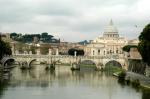
"In order to get into Rome, the city of the seven hills, one needs to cross over the Tiber River...
I am saddened by the way in which many people (myself included until recently) dismiss Catholics and 2000 years of history."

17,392 hits and 368 blog posts later, I hope and pray that I have been able to communicate some of the beauty and truth of Catholicism, even if at times, in a flawed and stumbling manner. The end of this month also marks the third anniversary of my return to the Catholic Church along with Prodigal Daughter.

Many thanks to all my kind and thoughtful commenters that visit and contribute to the blog. One of the greatest joys for me was discovering how truly universal this Church is. In the past year, I have met converts and reverts from Canada, Great Britain, Nebraska, N. Carolina, Florida, Texas, California, Nevada, etc who have had nearly identical journeys of faith and discovery. I am also so grateful for the many faithful "cradle Catholics" who knew what(Who) they had and never left.

My prayers are offered to all my "silent readers" that may be dipping their toes into the Tiber or walking along the banks and looking across from a distance. May our Lord and Savior draw you closer to Himself through His riches in the one, holy, catholic and apostolic church.

Thursday, April 26, 2007

Running Mom Blog/New Convert


The Church sure took in a lot of converts this past Easter Vigil. I love these conversion stories! It's exciting to see them develop. Always different but always similar too. Welcome Home Running Mom and Hubby! She was an evangelical Protestant married to a Catholic and they were attending an Anglican church.
Please keep all the new converts in your prayers and give her a great big Catholic bloggers welcome.
God bless.

"Lucky Turtles!"


It is illegal to kill baby turtles in Mexico. Kill a turtle or its eggs and go to jail.
It is now legal to kill baby humans in Mexico City. Kill a unborn human and ....
nada.

"We go to great lengths to protect (sea) turtle eggs," city lawmaker Paula Soto, a Calderon party member, told the Associated Press. "Lucky turtles! It appears they have more people willing to defend them than some unborn children."

Catholic leaders took a strong stand on the issue--Mexico City Cardinal Norberto Rivera led a demonstration through the capital against the abortion proposal last month. Cardinal Rivera is expected to make a public statement on the law’s passage on Sunday. Pope Benedict XVI sent a letter last week to Mexico’s bishops in support of the efforts to prevent the law’s passage--the Pope said Christ’s victory over death was a reason to defend everyone’s right to life “from the first moment of their conception.”

When Our Lady appeared to Juan Diego, almost 500 years ago just thirty miles north of Mexico City, the ritual human sacrifices ceased as millions of souls were converted to Christ. Far be it for me to say, but I think we could use an apparition right about now.

God have mercy.
Mary, bring the prayers of your children to your precious Savior to prevent this holocaust in a land once dedicated to you.

Wednesday, April 25, 2007

The Heart Beat of God, a Story of John


Chapter 2

Some 70 years since the Last Supper, John's teachings from the Lord himself were still fresh in the mind of Ignatius. He continued to spread the apostolic traditions of this rapidly growing church. In Peter’s first mission church in a city named Antioch, Ignatius was appointed bishop by the laying on of hands. As Peter and Paul laid hands on Ignatius, he imagined what it must have been like for Peter when Jesus did the same to him so many years before. Ignatius silently prayed for the strength and grace to receive this anointing.

Under his watch as bishop, there were rumors circulating about a teaching that Jesus was not truly God in human flesh. People claimed that Jesus only seemed to have a physical body and to physically die, but in reality he was incorporeal, a pure spirit, and did not physically die in the crucifixion. Being discipled directly from the one who wrote that “the Word was made flesh and dwelt among us”, Bishop Ignatius bristled at the thought that people calling themselves Christians could be saying such things. It was his solemn responsibility to Christ and his Church to set the record straight regarding the apostles teachings. The writings of Ignatius proclaim that not only was Jesus, God in human flesh, but that he continues to remain with the Church through the Eucharistic sacrifice.

“From Eucharist and prayer they hold aloof, because they do not confess that the Eucharist is the Flesh of our Savior Jesus Christ, which suffered for our sins, and which the Father in His loving-kindness raised from the dead.

Take care, then, to partake of one Eucharist; for, one is the Flesh of Our Lord Jesus Christ, and one the cup to unite us with His Blood, and one altar, just as there is one bishop assisted by the presbytery and the deacons, my fellow servants. Thus you will conform in all your actions to the will of God.”

“I have no taste for corruptible food or for the delights of this life. Bread of God is what I desire; that is, the Flesh of Jesus Christ, who was of the seed of David; and for my drink I desire His Blood, that is, incorruptible love....”.

Bishop Ignatius bravely finished his earthly sojourn in the Roman Coliseum where he was thrown to the wild beasts for love of his Savior. Some of his remains were brought back to the city of Antioch to be venerated (honored). In 637 AD, they were returned to Rome and reside in the Church of St. Clement where they can be seen today.

2000 years later we can still partake of His incorruptible love in the Eucharist.

More on the Early Church and the Eucharist here.

Tuesday, April 24, 2007

Catholic Basement Tapes / Sacramentals

Here is the second podcast from Tiber Jumper Studios. Prodigal Daughter and I discuss the role of sacramentals in a Catholic Christian's life. The difference between Sacraments and Sacramentals are discussed. Why do two ex-evangelical Christians find sacramentals (incense, rosary beads, crucifix, the sign of the cross, statues, etc) useful in growing closer to Jesus?
Tune in to the downloadable podcast and find out! It's about 12 minutes long.

Prayer Request

I have a special request for all my blogger readers and friends.
A young lady of 26 years was recently diagnosed with breast cancer and will need a mastectomy.
She is an acquaintance of my friend Pilgrimsarbour. Her name is Jeannine.
Please lift her needs to the Lord in prayer.
Thank you and God bless.

The Heart Beat of God, a Story of John


Chapter 1
The Apostle John, one of the original disciples of Jesus was nearing the end of his life. Being the youngest of the twelve, he had now out-lived all the other disciples. He also lived with Mary, the Mother of his Lord for a time in Ephesus caring for her as his own and they often recounted the events that changed their life. Later, as an old man, he was exiled to Patmos where Jesus gave him the revelation which over 200 years later became the last book to close the canon of Sacred Scripture.

As old as he was, his mind was still sharp and he could recall in detail each moment spent with his friend and Savior. The stories, the parables, the miracles and Jesus final days in Jerusalem were as real to him as if they had just happened. He remembered what it was like to lay his head on Jesus breast at the Last Passover they shared together. Some nights he would awaken from a dream thinking he could still hear the heartbeat of God, only to realize it was his own. A bittersweet longing would come over him as he realized that he would soon be able to once again lean his head on his friend and savior at the great marriage feast of the Lamb. Despite the rumors that circulated after the resurrection regarding his immortality(Jn 21:23), John always knew that this time would come.

He had spent his life preaching, teaching and discipling others in the ways and words of His friend and Master. As a result, he attracted a group of dedicated believers who hung on his every word as he shared the truths the Savior entrusted to him. Two of John's disciples, Ignatius and the younger, Polycarp, were captivated by the teachings that John shared with them and came to love Jesus very much. They were committed to spreading his teachings with the same fervor that John had. Ignatius couldn't remember the event, but was told he was the infant that Jesus lifted on his knee when the mothers brought their children to him for a blessing.

In the year of 100 AD, the apostle John, "the one who Jesus loved", finally breathed his last and once again joined his friend and savior.

Continued here

Official Company Policy


St. Jimbob of The Apocalypse suggested I post the Creed as a way of illustrating what the "official company policy" is of Catholics and non-Catholic believers as well. ( You are Catholic, you just don't know it yet!)
To be sure, the management can't be held responsible for employees who don't abide by company policy when off the premises though!

We believe in one God, the Father Almighty, Maker of heaven and earth, and of all things visible and invisible;
And in one Lord, Jesus Christ, the Son of God, the Only-begotten, Begotten of the Father before all ages, Light of Light, True God of True God, Begotten, not made, of one essence with the Father, by Whom all things were made:
Who for us men and for our salvation came down from heaven, and was incarnate of the Holy Spirit and the Virgin Mary, and was made man;
And was crucified also for us under Pontius Pilate, and suffered and was buried;
And the third day He rose again, according to the Scriptures;
And ascended into heaven, and sitteth at the right hand of the Father;
And He shall come again with glory to judge the living and the dead, Whose kingdom shall have no end.
And we believe in the Holy Spirit, the Lord, and Giver of Life, Who proceedeth from the Father, Who with the Father and the Son together is worshiped and glorified, Who spoke by the Prophets;
And we believe in One, Holy, Catholic and Apostolic Church.
We acknowledge one Baptism for the remission of sins.
We look for the Resurrection of the dead,
And the Life of the age to come. Amen.

Monday, April 23, 2007

American Catholic Idol


I have recently received some comments regarding my post about RRA Syndrome. Some of the commenters have suggested that despite what I am posting, they have found internet evidence that Catholics do indeed worship idols and Mary worship is implied by select quotes from papal encyclicals. With no ill will, they request honest clarification of this conundrum.

My frequent commenter, Theo, suggested that I put a call out to all Catholics who worship somebody or something other than the God of the universe, the blessed Trinity.

"Tiber, I suggest you might lovingly and openly invite any and all practicing Catholics who worship anything or anyone other than the one and only holy trinity: God the Father, God, The Son and God, The Holy Spirit to post here and explain who or what it is that they worship, and from where they got the notion to do so."

Well, Theo, You put me up to this! Here goes:

Calling All Idol Worshiping Catholics:
Don't be shy!
Tell us who you worship and why?

Let the Voting Begin (Remember, Just Catholics!)
Surveys - Take Our Poll

(I just hope my internet provider's bandwidth can withstand the deluge of posts I am expecting from this call. I usually get between 80-120 hits a day on my blog (unless Dr. James White posts about me, then I can get anywhere from 400-745 a day) so surely after 17,000 or more site views in the past year, I will have an ample sampling of idolatrous Catholics to draw from.)

More Idle Thoughts About Catholics and Idols

Here's a recent comment from Theo on the RRA Syndrome

"Tiber said (as he's said before)...

"You can't judge a religion by the people who don't practice it!"

I reply...

Indeed! In addition, let's remember that *real* judging is Jesus’ domain--and that His judgment is ultimately of individuals, according to what they have and have not done, not of any "religion" en masse, thank God.

I am grieved whenever I am directed to any report of Catholics giving to anyone other than God, the honor and worship due Him alone. Yet in truth, knowing many thousands of Catholics, I've never encountered one who once learning the very concept of "worship" did not know that worship is for God alone. I've never encountered a single one who actually worshiped anything or anyone but God, alone.

Frankly, I'd be utterly amazed to encounter one and would truly like to speak with him or her. If we are burdened for the unity of all the Church, we are best served by looking to the state of our own house. He who says that he loves the Lord, but fails to provide for his own family is more culpable than any infidel.

Tiber, I suggest you might lovingly and openly invite any and all practicing Catholics who worship anything or anyone other than the one and only holy trinity: God the Father, God, The Son and God, The Holy Spirit to post here and explain who or what it is that they worship, and from where they got the notion to do so. I suspect you will not get a reply from genuine Catholics; however, if you do, then I can imagine nothing better than asking by God's grace wisdom enough to address so vile a misconception."

I am going to take you up on this Theo!

Sunday, April 22, 2007

The Mountains Proclaim.....

Saturday, April 21, 2007

Romish Receptive Aphasia - A New Syndrome


There is a recent medical phenomenon that I believe I might be the first to have noticed. It is a neurologic condition that involves the senses, in particular, the auditory pathway of reception. It is rather complex and my research is at this point empiric and preliminary but I post in the hopes that other bloggers have noted it. Perhaps with enough data collected, I may be able to formulate a plan of therapy and perhaps, a safe and effective treatment.

I have tentatively called it Romish Receptive Aphasia. In medical parlance, a receptive aphasia is a neurologic condition caused by a cerebrovascular accident leaving the victim incapable of understanding speech via the auditory pathways. Interestingly enough, a person with receptive aphasia can sometimes perceive written language via the visual tracts without difficulty but has marked difficulty in receiving the correct auditory message through the aural pathway(ears).

What makes Romish Receptive Aphasia , (which I shall heretofore refer to as RRA) so interesting and frustrating is that it is an intermittent disorder which presents when the sufferer is confronted with auditory stimuli with Catholic content or terminology. (It may be a more physiologic disturbance rather than anatomic abnormality as the diagram suggests.) Symptoms also have been known to manifest to a lesser degree in the presence of icons, prayer books, rosary beads and other Catholic paraphernalia.

On Easter's eve, I was having a light after-dinner conversation with a non-Catholic relative when he asked me about "salvation." I fingered my scapular under my shirt as I drew a deep breath. As I calmly attempted to answer his questions, I realized he was experiencing an acute attack of what I now believe is RRA Syndrome. It went like this:

Victim said:
Catholics worship idols!
I said: Catholics worship God alone.
This is what the victim heard me say (RRA kicked in): Catholics don't worship God alone. We worship idols!
Victim said: But don't you Catholics believe that you need idols like Peter and Mary to get into Heaven?
I said: Catholics don't worship idols and we believe in Christ's sacrifice on the cross as the only way to heaven. We honor Mary, Jesus' Mum and respect the Popes, but don't believe they get us to heaven.
This is what the victim heard me say(with RRA) : We worship Mary and the Popes and don't believe Christ's sacrifice is enough to get us to heaven.
Victim said: You pray to dead people so you believe there is more than one mediator between God and man .
I said:
Regarding Salvation, Catholics believe there is only one mediator between God and man, Christ Jesus. The saints we pray to make intercession for us before the throne of God. They are not dead, but are alive and interceding for us as the early Church believed and declared in the Creed of Nicea and as Revelations speaks of.
This is what the victim heard: Regarding salvation, we have a whole host of other dead people we believe and trust in before we would even start to pray to Jesus! Besides we believe in non-scriptural sources such as The Creed which isn't in the Bible to make up our own doctrines!
Victim Said: Besides, I don't agree with any of these doctrines and your interpretation of those scriptures from Revelation. Because after all, Catholics worship idols .....

So there you have it. An actual case study documented, a neuro-religious phenomenon known as Romish Receptive Aphasia. If any of my readers have experienced what they feel may be a similar case, please share it with me.

In retrospect, I too had the RRA Syndrome 5 years ago when my wife first started to share Romish thoughts with me.
(I am making a self-diagnosis here)
When she said "I have been thinking about returning to the Catholic Church,"
I heard: I want to join that church of infidels and man-made religion.

But alas, Jesus cured me of the RRA syndrome.


And he took him aside from the multitude, and put his fingers into his ears, and he spit, and touched his tongue; And looking up to heaven, he sighed, and saith unto him, Ephphatha, that is, Be opened.

Why Is the Eucharist Really So Hard to Swallow?


For many of our non-Catholic brethren and some Catholics as well, the doctrine of the Real presence of Christ in the Eucharist (transubstantiation) is very hard to swallow. We are told it is nonsensical to believe God would reveal himself to us in the breaking of the Eucharisted bread and wine. The conservative Protestant theologian Louis Berkhof, in his famous work Systematic Theology, insists that the Roman teaching “. . . violates the human senses, where it asks us to believe that what tastes and looks like bread and wine, is really flesh and blood; and human reason." But doesn't the very definition of faith at some level imply a denial of human senses and reason? Therefore, we are either incredibly foolish heretics for believing this, or by God's grace alone, have been given the eyes of faith to see this.

It takes faith to believe in what the senses can't reveal to us. We are called idol worshipers for Eucharistic adoration because we place the Eucharistic Christ in a monstrance for hours of worship. To eyes that can't see, it appears we are bowing to a thin white wafer made of unleavened wheat.

But as a Christian, don't we believe a lot of things by faith? Don't we accept a lot of "nonsensical" things that Scripture tells us about the workings of God? After all, faith is believing what is not seen (by our senses). "Blessed are you who believe who have not seen."

It takes faith to believe....

in God and his three in one nature.
He created the world out of nothingness
He made Adam from the dust
Abram's wife conceived at 90 some years old
He flooded the earth(pre-figurement of dying in the waters of baptism)
Noah and his family lived on an ark for 40 days
He rained frogs on the Egyptians and the rivers turned to blood

He parted the Red sea for Moses ( another "shadow" of baptism)
He fed the people manna in the desert, bread from heaven (shadow of the Eucharist)
They got water from a rock
They were healed upon gazing at the serpent on a staff (even so must the son of man be lifted up)
Naaman was healed of leprosy by the waters of the Jordan
The miracle of Elijah and the prophets of Baal
That God used Elijah's bones to raise someone from the dead (OT use of relics)

That God came to earth and took human flesh..... (moment of silent reflection here)

That John the Baptist being conceived in the womb of a barren women jumped for joy, still in the womb, when he was in the presence of his Savior in Mary's womb?


That Jesus turned water into very good wine,
That Jesus turned a few loaves and fishes into a feast for 5000
That Jesus used mud and spit to heal blindness (was it the clay that healed the man or was it Jesus working through material things?)
That He has the very hairs of our head counted

That the God-man would go to the cross willingly to suffer and die for the sins of all humanity
That He would rise again in three days
That He would give power to men on earth to forgive sins (Jn 21)
That He could start a Church 2000 years ago that the gates of Hell have not yet prevailed against.

So if most of Christendom has enough faith to believe that the God of the universe can do all those things, why can't we believe that this very same God who came to us as a man continues to come to us in the Bread of Life as he promised?
So Why Is the doctrine of the Eucharist really so hard to swallow?


"Material food first changes into the one who eats it, and then, as a consequence, restores to him lost strength and increases his vitality. Spiritual food, on the other hand, changes the person who eats it into itself. Thus the effect proper to this Sacrament is the con­ver­sion of a man into Christ, so that he may no longer live, but Christ lives in him; conse­quent­ly, it has the double effect of restoring the spiritual strength he had lost by his sins and defects, and of increasing the strength of his virtues."
St. Thomas Aquinas
, Commentary on Book IV of the Sentences, d.12, q.2, a.11

Friday, April 20, 2007

Rowan Scriptura


The leader of the Anglican Church recently told theology students that conservatives misread the Scriptures regarding homosexuality*.

Archbishop of Canterbury Rowan Williams told a group of theological students that the scriptural text conservatives use to argue against homosexuality is misread.

The Anglican spiritual leader was speaking in Toronto on Monday when he examined the practice of reading the Bible. He said the primary point of the most important single text in Scripture on the subject of homosexuality – for the majority of modern readers – is not about homosexuality. Instead, it's meant to warn Christians not to be self-righteous when they see others fall into sin."

"Paul is making a primary point not about homosexuality but about the delusions of the supposedly law-abiding," he stated, according to the Anglican Church of Canada.

For 2000 years, the Catholic Church has had a consistent teaching regarding sexual morality based on its interpretation of Sacred Scripture and Sacred Tradition. With all due respect to this respected church leader with an amazing intellect, does anyone else scratch their head and wonder how the Scriptures had been misread for so many years by "conservatives"? I think we underestimate the power of the Holy Spirit and nullify Christ's promise to lead us in all truth when we assume that we could have been mistaken and misread Scripture for almost 2000 years! It is incredulous to me that after 1900 years, one enlightened individual could come along and read Paul's epistle the way he originally intended it to be read.

*Please note just to clarify, this post is not to bash homosexuals. The Catechism of the Catholic Church states this regarding homosexuality:

"The number of men and women who have deep-seated homosexual tendencies is not negligible. This inclination, which is objectively disordered, constitutes for most of them a trial. They must be accepted with respect, compassion, and sensitivity. Every sign of unjust discrimination in their regard should be avoided. These persons are called to fulfill God's will in their lives and, if they are Christians, to unite to the sacrifice of the Lord's Cross the difficulties they may encounter from their condition."

Thursday, April 19, 2007

"The Real Presence"


Pilgrimsarbour reminds me in his comment on a recent post that a lot of my writing (and podcasting now) seems to come back to the Eucharist. Come to think of it, he's right!
Susie from ReCon had a nice post about the term Real Presence. Dwight Longenecker, the author of the piece warns that real presence originally came from an Anglican source and does not convey the Catholic belief that Christ is truly present in the Eucharist, body, soul and divinity.
What struck me in the article was that the Eucharistic doctrine of Catholicism continues the very important incarnation, God's intrusion into our world. From the very beginning of Christianity, Jesus birth, life, death and resurrection informs the world that God is here with us in a very real sense and continues to use the material world to bring his grace.
The Eucharist is not a novel concept but continues to promote the incarnational aspect of Christianity. The same God that has the power to come to earth as a man, continues to come to us in the appearances of bread and wine yet is truly the substance of Jesus; body, soul and divinity. Yes, it definitely takes faith to accept this.
Thomas Aquinas, said this :

"I answer that, The presence of Christ's true body and blood in this sacrament cannot be detected by sense, nor understanding, but by faith alone, which rests upon Divine authority. Hence, on Lk. 22:19: "This is My body which shall be delivered up for you," Cyril says: "Doubt not whether this be true; but take rather the Saviour's words with faith; for since He is the Truth, He lieth not."
Theo said...

Tiber Jumper wrote in part...
"The same God that has the power to come to earth as a man, continues to come to us in the appearances of bread and wine yet is truly the substance of Jesus; body, soul and divinity. Yes, it definitely takes faith to accept this."

I comment...
Well said, Tiber! You remind me of a conversation I had some thirty years ago with a very good Calvinist friend. He considered me to be some sort of anomaly: a "Christian Catholic;" whereas I described myself as a "Catholic Christian" which I considered no more anomalous than "Reformed Christian" or "Evangelical Christian."

Though he accepted my Christianity as genuine, he was dismayed by my persistent belief in transubstantiation. "Do you honestly believe," he would ask me, "that Almighty God could change store-bought bread and store-bought wine into Himself?" (I don't know why he felt "store-bought" somehow made the notion even less believable.)

My reply was , "Do *you* honestly believe that Almighty God could not?"

With humble prayers,
--Theo


Wednesday, April 18, 2007

Supreme Court Criminalizes Sucking the Brains Out of Premature Infants


"The Supreme Court upheld the Partial Birth Abortion Ban Act in a 5-4 decision April 18. The ruling was lauded by abortion opponents, including President George W. Bush, who called partial-birth abortion an "abhorrent procedure" in an April 18 statement from the White House."

"Finally," said National Right to Life Committee legislative director Douglas Johnson, "it is illegal in America to mostly deliver a premature infant before puncturing her skull and removing her brain, which is what a partial-birth abortion is."

Dr. C. Everett Coop, former U.S. Surgeon General, stated, “... in no way can I twist my mind to see that the late-term abortion as described is a medical necessity for the mother. It certainly can’t be a necessity for the baby.”

Thank you Jesus !

Eternal God in whom mercy is endless and the treasury of compassion inexhaustible, look kindly upon us and increase your mercy in us that in difficult moments we might not despair nor become despondent but with great confidence submit ourselves to Your holy will which is love and mercy itself, amen.(closing prayer of the Divine Mercy Chaplet)

Monday, April 16, 2007

Pray For the Students and Families of Virginia Tech

"O My Jesus, forgive us our sins and save us from the fires of hell.
Lead all souls into heaven, especially those in most need of your mercy."

"Eternal Father, I offer you the Body and Blood, Soul and Divinity, of Your dearly beloved Son, our Lord Jesus Christ, for the atonement for our sins, and those of the whole world. For the sake of His sorrowful passion, have mercy on us, and on the whole world."

"Hail Mary, full of grace, the Lord is with Thee. Blessed art thou amongst women and blessed is the fruit of your womb, Jesus.
Holy Mary, mother of God, pray for us, sinners, now and the hour of our death."
Amen
