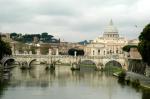
Crossed The Tiber

An Evangelical Converts to Catholicism

My Photo
Name:
Location: Pennsylvania, United States

I was born into the Catholic faith. At 14, I was "born again" and found Jesus personally but lost His Church. After thirty years as an evangelical protestant, I have come full circle to find that He has been there all the time, in the One, Holy, Catholic and Apostolic Church. I wish others to find the beauty and truth of the Catholic faith as I have found.

Wednesday, April 02, 2008

A Memorable Week


What a week so far! March 31st was the 3rd anniversary of the legalized murder of Terry Schiavo and today is the3rd anniversary of the passing of the Late Great John Paul 2.

John Paul 2 was a strong advocate for the cause of life from conception to natural death and made a statement regarding nutrition and hydration in an effort to address the unfolding situation in Florida one year before Terry's murder by starvation meted out by the court system in Pinellas County, Florida. For more information on this, please check out this site and consider supporting their ministry.

I had come into the Catholic Church one year before Pope John Paul died. In that one year I had grown extremely fond of him and his writings. The day he died, I wept. I felt somehow connected to him as did millions across the planet.

This week, please remember to continue to pray for the forces in our country that seek to end the life of the disabled (cognitively and physically) in the name of "mercy."

I suspect John Paul 2's intercession before the throne in this regard will be especially efficacious as he certainly is a righteous man. (His canonization process is proceeding rapidly and miracles attributed to his intercession have already been documented.)

Pope John Paul 2, as we remember you on this day, we ask you to pray for this country and the lives of those who are viewed as valueless and disposable. You modeled redemptive suffering in your own life. Pray that we will understand this gift in our own lives and those who suffer around us. Pray for those who are no longer valued by society because of cognitive or physical disabilities , especially the frail elderly and those who can't speak for themselves. We ask this of you through the mercy and grace of our Lord Jesus Christ. Amen

Labels: ,

Thursday, April 12, 2007

What is the Quality of Life? A Euphemism for Euthanasia


In my medical training in the 1980's the term quality of life was often used when a patient's case was discussed and an illness was becoming increasingly difficult to treat or care for. It was assumed that if a patient's quality of life was poor, then the decision to continue pursuing aggressive treatment needed to be re-evaluated. Even as a Christian physician, with no training or teaching in ethics, I adopted this quality of life approach to decide on treatments. It seemed that most of my colleagues based treatment decisions on what quality of life we judged the patient to have given a particular disease or condition. Everyday, nurses and doctors in long term care facilities use "quality of life" arguments to decide why they shouldn't pursue a treatment or remedy in a "difficult case." Quite frankly, it is much easier and cheaper to do nothing for a patient, than to carefully palliate a condition providing adequate pain control and comfort measures without shortening the life of a patient.

Part of our society's acceptance of the "quality of life" paradigm lies in the failure to face or embrace suffering. We are taught to end suffering at all costs and now, in Oregon, that translates into taking the life of a person to "end their suffering." Modern society has no theology to handle suffering and hence suffering is considered the enemy and must be vanquished at all costs. As a practitioner of the healing arts, I am obligated to relieve suffering to the best of my ability but I also acknowledge that all life ultimately involves some degree of suffering. As John Paul 2 reminds us, Jesus not only redeemed us by His suffering but He redeemed suffering itself, so that suffering is not without value if united with Christ's suffering. (Col 1:24)

It was not until my conversion to Catholicism and my exposure to Catholic medical ethics that I started to see the pernicious aspect of this quality of life argument. Catholic theology teaches that Life itself is a good, because God created life. Therefore, it is not up to me to make a judgment of whether the quality of someone's life is "good." During the late 1930's in Europe, handicapped, mentally retarded and ill people were judged to have a poor quality of life and became the target of Nazi Germany's euthanasia program. (along with Jews, Catholic priests, gypsies and homosexuals) The photo above was the graves of victims of euthanasia in Austria during 1941. They were "defective" German citizens or the incurably ill.

Without firm guidelines and teaching in Christian ethics, even well meaning Christian health professionals can be caught up in the quality of life approach to health care. I considered myself a devout Christian physician but had no training in the Christian approach to medical ethics in health care. I am thankful for the wealth of information available to me in the Church and have availed myself of our diocesan ethics specialist at times for consultations. I no longer feel like I am "flying by the seat of my pants" when attempting to navigate complex medical/ethical decisions for the frail elderly population I care for.


"Even when not motivated by a selfish refusal to be burdened with the life of someone who is suffering, euthanasia must be called a false mercy, and indeed a disturbing "perversion" of mercy. True "compassion" leads to sharing another's pain; it does not kill the person whose suffering we cannot bear. Moreover, the act of euthanasia appears all the more perverse if it is carried out by those, like relatives, who are supposed to treat a family member with patience and love, or by those, such as doctors, who by virtue of their specific profession are supposed to care for the sick person even in the most painful terminal stages." - The Gospel of Life, #66 - John Paul II, 1995

Sources of Medical Ethics
Catholic Medical Association
Evangelium Vitae/The Gospel of Life
National Catholic Bioethics Center
Priests For Life

Labels: ,

Tuesday, January 23, 2007

More Pics From March for Life 2007


Most of the time we spent marching, our hearts were in our throat and we were on the edge of tears as we saw posters like this one above. There were also the more graphic and gruesome photos of the "products of conception."(Dismembered humans) Either way, the sanctity of life and reason for our march was reinforced by images as these. Perhaps most moving for me was the large group of men and women gathered at the steps of the Supreme Court from Silent No More. These men and women bravely came to say that they regretted their decision to abort their children. I viewed them as brave penitents who are now helping to prevent others from making the same tragic mistake


"The moral gravity of procured abortion is apparent in all its truth if we recognize that we are dealing with murder and, in particular, when we consider the specific elements involved. The one eliminated is a human being at the very beginning of life. No one more absolutely innocent could be imagined. In no way could this human being ever be considered an aggressor, much less an unjust aggressor! He or she is weak, defenceless, even to the point of lacking that minimal form of defence consisting in the poignant power of a newborn baby's cries and tears. The unborn child is totally entrusted to the protection and care of the woman carrying him or her in the womb."
{Pope John Paul II ~ Evangelium Vitae}

"Being unwanted is the worst disease that a human being can ever experience." ~ "Any country that accepts abortion is not teaching its people to love, but to use any violence to get what they want. This is why the greatest destroyer of love and peace is abortion."
{Blessed Mother Teresa of Calcutta}


Labels: ,

Monday, September 25, 2006

I Forgive, I Forgive


"I Forgive, I Forgive..." Sister Leonella 9/2006
These were the last dying words of an elderly religious sister who was shot 3-4 times in the back as she left a missionary hospital in Somalia where she had worked for the past thirty years.

"What we talked about will have to remain a secret between him and me. I spoke to him as a brother whom I have pardoned and who has my complete trust." Pope John Paul II's comments about his prison visit with his attempted assassin.

"Forgive them , they know not what they do."
Jesus

Labels: ,

Saturday, September 02, 2006

John Paul 2 on the Redemptive Value of Suffering


"Saint Paul speaks of such joy in the Letter to the Colossians: "I rejoice in my sufferings for your sake"(88). A source of joy is found in the overcoming of the sense of the uselessness of suffering, a feeling that is sometimes very strongly rooted in human suffering. This feeling not only consumes the person interiorly, but seems to make him a burden to others. The person feels condemned to receive help and assistance from others, and at the same time seems useless to himself. The discovery of the salvific meaning of suffering in union with Christ transforms this depressing feeling. Faith in sharing in the suffering of Christ brings with it the interior certainty that the suffering person "completes what is lacking in Christ's afflictions"; the certainty that in the spiritual dimension of the work of Redemption he is serving, like Christ, the salvation of his brothers and sisters. Therefore he is carrying out an irreplaceable service. In the Body of Christ, which is ceaselessly born of the Cross of the Redeemer, it is precisely suffering permeated by the spirit of Christ's sacrifice that is the irreplaceable mediator and author of the good things which are indispensable for the world's salvation.
It is suffering, more than anything else, which clears the way for the grace which transforms human souls. Suffering, more than anything else, makes present in the history of humanity the powers of the Redemption. In that "cosmic" struggle between the spiritual powers of good and evil, spoken of in the Letter to the Ephesians(89), human sufferings, united to the redemptive suffering of Christ, constitute a special support for the powers of good, and open the way to the victory of these salvific powers.
"

From the Apostolic Letter Salvifici Doloris 2/11/1984

Labels: , ,

Universalis