Crossed The Tiber

An Evangelical Converts to Catholicism

My Photo
Name: Tiber Jumper
Location: United States

I was born into the Catholic faith. At 14, I was "born again" and found Jesus personally but lost His Church. After thirty years, I have come to find that He has been there all the time. I am in love with Jesus and His Church. I am a part time geriatrician and internist and full time musician.

Tuesday, October 31, 2006

I Do Believe in the Communion of Saints


On the Eve of All Saints day, creedal Christians celebrate the continuing fellowship that extends beyond the confines of time and space and death. We take time out on All Saint's Day to commemorate the lives of the Saints, both known and unknown. We, like the early church, believe that the folks that have gone before us can continue to intercede for us while they are in heaven. We can ask them to intercede for us or using the old english term for ask, "pray". The saints are not divine, nor omnipresent or omniscient. They are not to be worshipped. All of this communion between them and us has been facilitated by the grace of God released through the death and resurrection of Jesus.

Not only can they pray for us, we can pray for those being perfected in purgatory as Maccabees in the Old Testament illustrates, and St. Paul's comments about Onesiphorus his helper suggest. Purgatory isn't a "second chance" to get into heaven. If a soul is in purgatory, they are already "in" so to speak, but need a little purifiying since no unclean thing can see God, so as CS Lewis suggests needs a "bit of cleaning up." Purgatory is kind of like "heaven's washroom", where we go for purification before we see the Holy One face to face.

I blogged a bit more on this here in the past.

Monday, October 30, 2006

Elvis, Eric and Relics

(Photo on the left) The heart of St. John Vianney

American society has a high regard for the memorabilia of pop stars, movie actors and famous politicians. Whether it's the teeth of George Washington, the scarves that touched Elvis' sweaty brow ($3000 on ebay) or the baseballs pitched by famous athletes, we have no problem with placing high monetary and cultural value on these inanimate objects sometimes referred to as relics.

I own a guitar string that was once on Eric Clapton's guitar. A pharmaceutical rep came to my office when I was still in private practice and held out a rusty guitar string and said "Guess whose guitar this was on?" I without hesitation said 'Eric Clapton', and he was dumbfounded. It was a lucky guess and the first guitarist that came to my mind. He explained that his neighbor worked at Martin Guitar Company in Nazareth, PA and had Eric Clapton over his house to discuss the new Eric Clapton Signature model guitar. They were jamming and Eric broke a string and the host kept it and gave it to his neighbor who gave it to me. It's probably not worth too much now, but when Eric goes to his reward it might be . Why? Because it touched Eric's body.
(His sweaty fingers to be exact.) So we humans know that there is a value in touching something and honoring something that was a part of or touched a famous person or someone greatly admired. Shortly after my wife died, I would sometimes go in the closet just to smell her shirt or scarf to remember her, to honor her. But I didn't worship the shirt . It just helped me to connect to her memory in a very real physical way and to honor her.

Well, that's what Catholics believe about the relics of saints. They are either a part of the body(1st class) of a godly person gone to glory recognized as a saint, or something they owned or a personal effect (2nd class) or an item touched to any first or 2nd class relic (3rd class relic).
Where is this in the Bible? The veneration or honoring of relics is a concept borne from the Scriptures as well as defended and supported by the early Church Fathers.

Exodus 13:19 "And Moses took Joseph's bones with him: because he had adjured the children of Israel, saying: God shall visit you, carry out my bones from hence with you."4 Kings 13:20-21 "And Elisha died, and they buried him. And the rovers from Moab came into the land the same year. And some that were burying a man, saw the rovers, and cast the body into the sepulchre of Elisha. And when it had touched the bones of Elisha, the man came to life and stood upon his feet."

Matthew 9:20-22 "And behold a woman who was troubled with an issue of blood twelve years, came behind him, and touched the hem of his garment. For she said within herself: If I shall touch only his garment, I shall be healed. But Jesus turning and seeing her, said: Be of good heart, daughter, thy faith hath made thee whole. And the woman was made whole from that hour."
Acts 19:11-12 "And God wrought by the hand of Paul more than common miracles. So that even there were brought from his body to the sick, handkerchiefs and aprons: and the diseases departed from them: and the wicked spirits went out of them."
St Jerome: (340-430 AD)
We do not adore, I will not say the relics of the martyrs, but either the sun or the moon or even the angels -- that is to say, with the worship of "latria"...But we honor the martyrs' relics, so that thereby we give honor to Him Whose [witness] they are: we honor the servants, that the honor shown to them may reflect on their Master... Consequently, by honoring the martyrs' relics we do not fall into the error of the Gentiles, who gave the worship of "latria" to dead men.

The Idiot's Quick and Dirty Guide to Relics
God is a God of matter. He created matter and works through it. Blood, bread, wine, oil, mud, spittle, old prophet's bones, hems of garments, hankies, shadows etc . The Incarnation Himself shows us God works through the things of the earth.

1) Catholics don't worship relics! We venerate (honor) the memory of the person they pertain and that saint draws our hearts towards Christ, the source of all power and grace.
2) Relics have no Magic Power, or any power unto themselves.
3) Relics are never to be bought or sold! (Let's here it for the Council of Trent!) It was never an official position/teaching of the Church to allow relic sales.
4) They may be the occasion of miracles wrought by God (as in Elisha's bones) and many other documented healings in the history of the Church.
5) The use of relics can lead people to receive or respond to grace. They do not actually provide grace because they are just matter, only God can provide grace. This is the key message here.
6) There is strong historical evidence of the early church's veneration of bones, ashes of the martyrs and their tombs were often the site of prayer. After Polycarp, a disciple of John was burned at the stake: "We took up his bones, which are more valuable than precious stones and finer than refined gold, and laid them in a suitable place, where the Lord will permit us to gather ourselves together, as we are able, in gladness and joy and to celebrate the birthday of his martyrdom." Not worshipping the dead guy, but "the honor shown them may reflect on their Master, Jesus!"
7) Does anyone want to offer me some cash for Eric Clapton's guitar string? (just kidding)

Sunday, October 29, 2006

Pontificator Becomes a Papist Priest


“In the name of an ideology of radical inclusivity, the Episcopal Church has moved significantly away from the apostolic and catholic faith of Jesus Christ,” he said, adding that he “must be in the Church founded by Christ Jesus.” Fr. A. Kimel

This is probably old news but on December 3rd 2006, Al Kimel, a former Anglican priest will be ordained as a Catholic priest in the diocese of Newark, New Jersey at Our Lady of Souls Parish in South Orange, NJ.
He is the blogmeister of the award-winning blog "Pontifications" that he started as a Anglican priest about two years ago. He has chronicled his journey along with excellent commentary on theology, news and "all things Catholic."
He is about the eightieth Anglican priest to be ordained in the Catholic Church since the Pastoral Provision was made by the late John Paul 2 in 1980. Keep him in your prayers as well as the many Anglican folks who are struggling with the issues in their communion.

Apparently the flow of the tide "across the Tiber" sometimes goes both ways though. I read that there are forty Catholic priests a year who are leaving Catholicism to become Anglican. I suspect we are getting the best end of the stick in this exchange. It's about quality, not quantity. If you have read Pontifications, you will see the heart of a man committed to the Catholic Church and the folks that Father Kimel will serve will be blessed indeed.

St. John Vianney (patron saint of priests), pray for Father Kimel and his family as he accepts the mantle of responsibility of carrying forth the apostolic mission of the Catholic Church.

Saturday, October 28, 2006

The Spiritual Works of Mercy

Our Church also provides for us an outline of Spiritual Works of Mercy.
Prayers for the dead was evidenced by writings of the early church, ancient liturgy, as well as inscriptions on first century tombs and prove that the early church continued this practice of the Jews
St. Augustine in the 5th century speaks of prayers for the dead: "The universal Church observes this law, handed down from the Fathers, that prayers should be offered for those who have died in the communion of the Body and Blood of Christ, when they are commemorated in their proper place at the Sacrifice"

We are not all gifted with the ability to do the first three but the last four seem to be actions that we are all capable of through the power of the Holy Spirit.

Friday, October 27, 2006

The Corporal Works of Mercy

When an ex-evangelical like myself hears of terms like the above for the first time, I think "corporal punishment", "good works" blah, blah, blah etc. Sometimes my spiritual eyes would glaze over when I read or heard anything that sounded Catholic and I missed out on much truth and edifying material because of that.

The seven practices (works) of Catholic charity toward our neighbor's body (corpora) are:


1. Feeding the hungry
2. Giving drink to the thirsty
3. Clothing the naked
4. Sheltering the homeless
5. Visiting the sick
6. Visiting the imprisoned
7. Burying the dead

In this modern society, there is still ample opportunity to perform most of these if not directly than through the "dreaded work of dragging out the pen" and writing a check to an organization that does do these things.

One might say "Here they go again, Catholics talking about good works." Do we need to do these to get to Heaven?
I can assure you, Catholics believe that no one gets to Heaven without the redemptive work of Christ. He suffered and died for our sins and restored our fellowship with God. That being said, we also believe Scripture teaches that being empowered by God's grace to perform good works is a also a key component since "faith without works is dead". Catholics believe in faith and works, not faith or works. Let's hear what Jesus has to say about the works of mercy and how they figure into our eternal destiny. Matt 25

"When the Son of Man comes in his glory, and all the angels with him, he will sit upon his glorious throne,
32
and all the nations will be assembled before him. And he will separate them one from another, as a shepherd separates the sheep from the goats.
33
He will place the sheep on his right and the goats on his left.
34
Then the king will say to those on his right, 'Come, you who are blessed by my Father. Inherit the kingdom prepared for you from the foundation of the world.
35
For I was hungry and you gave me food, I was thirsty and you gave me drink, a stranger and you welcomed me,
36
naked and you clothed me, ill and you cared for me, in prison and you visited me.'
37
Then the righteous will answer him and say, 'Lord, when did we see you hungry and feed you, or thirsty and give you drink?
38
When did we see you a stranger and welcome you, or naked and clothe you?
39
When did we see you ill or in prison, and visit you?'
40
And the king will say to them in reply, 'Amen, I say to you, whatever you did for one of these least brothers of mine, you did for me.'
41
Then he will say to those on his left, 'Depart from me, you accursed, into the eternal fire prepared for the devil and his angels.
42
For I was hungry and you gave me no food, I was thirsty and you gave me no drink,
43
a stranger and you gave me no welcome, naked and you gave me no clothing, ill and in prison, and you did not care for me.'
44
Then they will answer and say, 'Lord, when did we see you hungry or thirsty or a stranger or naked or ill or in prison, and not minister to your needs?'
45
He will answer them, 'Amen, I say to you, what you did not do for one of these least ones, you did not do for me.'
46
And these will go off to eternal punishment, but the righteous to eternal life."


Thursday, October 26, 2006

I Love Penance!

This week I had the opportunity to spend part of two days in a Catholic high school in eastern Pennsylvania. My friend who is a priest and director of spiritual life at this school asked me to give a short talk after Communion. It was Homecoming Week and they wanted an outside speaker, so in front of 800 Catholic high school kids, I explained how I left the church and why I came back 30 years later. I let them know that the Church they are a part of is an amazing treasure and never take for granted the opportunity to get to know Jesus better through this Church. I got a little choked up talking about it, because I was overwhelmed with the fact that I had not been in a Catholic school since the first grade and here I was talking to all these students who hadn't abandoned ship on their faith and their Church! I was very humbled.
The next day I was invited back to speak to their pro-life group from a Catholic physician's perspective. As I entered the classroom, I saw crucifixes, posters of saints, scripture, textbooks called "Understanding Scripture", rosary beads and a poster of Our Lady of Guadalupe and pro-life banners and slogans all over the walls of the classroom.
Sister Margaret introduced herself and I met with about ten students. I had the opportunity to share with them the Catholic perspective on end-of-life issues as well as my own experience as a geriatrician caring for the frail elderly. The beautiful thing for me is that I had a wealth of information and guidelines provided to me by the Catechism, the writings of John Paul, so I wasn't just flying by the seat of my pants.

So where does penance come in? As I have mentioned before in my blog, when I returned to the Church and went to confession for the first time in over 30 years, my penance given to me was to tell folks that I meet what Jesus has done for me through His Church. These past two days were redemptive for me and God was so kind to allow me the opportunity to talk to Catholic kids about how great a Church they have. In some small way, it makes up for my high school years that I spent witnessing to Catholics to convince them to leave the Church. God is good!

Wednesday, October 25, 2006

O Be Careful Little Eyes What You See

"Families need to take a firm stance in safeguarding the threshold of their homes, in defending the dignity of each person. Guard your families against pornography, which nowadays under various forms affects people's minds, especially those of children and young people. Defend the purity of morals in your homes and in society. ... The purer families are, the healthier the nation will be."
- POPE JOHN PAUL II, Sandomierz, Poland, June 12, 1999


When my two boys were small, we gave them little Fisher-Price cassette players and fifteen years later, in my mind, I can still hear the refrains of the songs they played.

"Oh, be careful little eyes, what you see.
Oh, be careful little eyes, what you see.
There's a Father up above, looking down in tender love,
So be careful little eyes, what you see."

The ability to keep our hearts pure is so important. We can be forgiven by Christ for our sins of impurity (adultery actually) but the temporal consequences often don't fade so easily. Scientists say that the images of pornography are "burned" into our brain in our "flash memory" and often these images can come back decades later at the most inopportune times.
( Moments before receiving Christ in the Eucharist is one the enemy's favorite times for accessing these images.)

This upcoming week is Pornography Awareness Week which is promoted by the interfaith venture known as Morality in the Media. Let your pastors know there are resources available for sermons. We can create community awareness by wearing a white ribbon next week, October 29-November 3rd.

I am convinced that internet pornography in particular is the "invisible elephant" in the room for both Catholic and Protestant believers and we need to come clean before our Lord and families. I encourage you to download accountability software so that your closest confidant knows where "your little eyes" have been on the net. Time to "uncloak" the elephant and get him back to the zoo where he belongs!

Here is some prayers that I hope will assist you in the goal of purity.
(From Pure Intimacy, a ministry of Focus on the Family)

Prayer for Purity of Heart
Lord, help me to accept and receive my sexuality as a gift from you. Grant me the grace to resist the many lies that distort this divine gift and help me to live my sexuality according to the truth of self-giving love. Grant me purity of heart so that I might see the image of your glory in the beauty of others, and one day see you face to face. Amen.


Prayer for the Redemption of Sexual Desire
Lord, I praise you and thank you for the gift of my sexual desires. By the power of your death and resurrection, untwist in me what sin has twisted so that I might know and experience sexual desire as you created it to be as the desire to love freely, totally, faithfully, and fruitfully. Amen.

Prayer in a Moment of Temptation to Lust
Lord, thank you for the beauty of this person whom you made to be loved,never to be treated as a thing for my gratification. I renounce any tendency within me to use this person for my own pleasure, and I ask you to set my desires aright. Amen.

Prayer for Restoring God's Design
Lord, I confess my mind and conscience is corrupted. I claim to know you, but, by my actions, I deny you. Lord, I am unfit for your kingdom as I am. The Psalmist said, "Restore us, O God; make your face shine upon us, that we may be saved." I ask you, Lord, to restore me to the kind of life I was meant to live, including using my body in a way that is holy and honorable. Amen.

Prayer for Transformation of Sinful Desire
Lord, I number myself with those of your ancient Church in Corinth, which consisted, in part, of the sexually immoral, adulterers, male prostitutes, and homosexual offenders. But you are a God of Hope and transformation, for you told these Corinthians, "And such were some of you." I, too, have been washed and set aside for you, made whole by the redemptive actions of our Lord Jesus Christ and by the Spirit of our God. My identity is no longer captive only to my sexual focus or orientation; my identity is in your Son, Jesus Christ. You say, "if anyone is in Christ, he is a new creation; the old has gone, the new has come." Lord, wash away my old, sinful self and renew me in your Spirit to be a new creation. Amen.

Prayer for Purity of Body, Mind, and Soul
Lord, this physical body is a member of your Son,your temple, your dwelling place. It is not my own to do as I please. You have bought me with the high-priced passion of your Son. When I unite myself with you, I am one with you in spirit. Help me to concentrate on your holiness, peace, faith, a love that permeates all things, and to be in union with those who call on you with pure minds. Amen.

Tuesday, October 24, 2006

Search Me Oh God: Examining Your Conscience


My blog about internet pornography lead me to write about this. Catholic Christians have this great thing called "The examination of conscience." Sounds legalistic, and where is it in the Bible you say? Well, it's based on the Ten Commandments and is a wonderful tool the Church has given us to allow the Holy Spirit to speak to our hearts about where we might be hiding or sequestering sinful, thoughts actions or motives. Psalm 139 23-24 says "Search me, O God, and know my heart: try me, and know my thoughts: 24 And see if there be any wicked way in me, and lead me in the way everlasting." That's what you are praying when you perform an examination of conscience.

Man, if I used this as an evangelical, I would have been in much better shape spiritually! Instead I sometimes took the "I'm free in the Spirit and forgiven so I can do whatever the heck I want" approach. I didn't really think that but sometimes my life reflected that philosophy. The "once saved always saved heresy" can really be a deadly trap. Even though we were encouraged to "keep short accounts with God" I never understood how to do that and mumbling a few "I'm sorry Jesus" before falling to sleep seemed to suffice....sort of. By thinking we can't lose our salvation, the concept of a "sin unto death" (as 1 John says) loses its meaning. Catholics call that mortal sin to distinguish it from venial sins that don't lead to spiritual death, at least not immediately.

The beauty of the the examination of conscience is that it is a tool to be used in conjunction with and preparation for the sacrament of reconciliation. We are not just left hanging on a hook after God shows us our sins. He then takes them all and forgives them through the power he gave through His Church which he obtained for us by his death on Calvary. The priest doesn't forgive sins, Jesus forgives us through the priest in our act of humbling ourselves before God in the confessional. Of course we aren't forgiven unless we are truly sorry, but that goes without saying. Here's the examination of conscience using the Ten Commandments .

The First Commandment:
I am the Lord your God; you shall not have strange gods before me.
Do we truly love God above all, or do we sometimes give greater importance to things of this world: money, image, looks, clothes, popularity or selfish desires?
Do we claim to have good values, but often bend or abandon them in order to fit in and be "part of the group?"
Do we turn to God in thankful prayer, or do we pray mostly when we want something?
Do we really want to be transformed by the will of God, or do we just use our religion in order to "look" like good Christian people?
The Second Commandment:

You shall not take the name of the Lord in vain.
Do we show disrespect for God's name by misusing it out of frustration or anger or to look "tough" to others?
Do we hesitate to mention God's name in appropriate situations, in conversations with friends and family members?
Do we continue to learn about God by paying attention in Church, Christian education and through reading orthodox Catholic periodicals, and scripture?
Do we view movies that use vile language and take the Lord's name in vain?
The Third Commandment:

Remember to keep holy the Lord's day.
Do we come to Church to celebrate the Eucharist on Sundays and Holy Days? Do we attend Mass only when it is convenient or when it will make us "feel good?"
Do we participate in the Eucharist by praying and singing, or do we simply sit as spectators and wait to be entertained?
Do we pay close attention to the Word of God and open ourselves to God's call to allow His word to take effect in our lives?
Do we acknowledge the "true presence" of Christ in the Eucharist and receive Holy Communion with respect and reverence?
The Fourth Commandment:

Honor your father and your mother.
Do we help bring peace and happiness to our families, or are we disrespectful of others and a source of hurt and division for those who are closest to us?
As parents, are we generous and patient with our children? Do we spend time with them and give them the attention they need? Do we set responsible limits for them and make sure they follow rules that will help them grow into responsible adults?
Are we willing to say "no" to our children, or are we more likely to ignore problem behavior and hope it will "go away?"
Do we listen to our children carefully and treat them with respect?
As children, are we loving, respectful and obedient to our parents? Do we appreciate the many sacrifices they make for us? Do we say "Thank you" and "I love you" often enough?
Do we do our chores without being asked, or do we wait for our parents to become upset before we move away from what we are doing?
Do we listen to our parents' reasoning when they say "no" to us?
The Fifth Commandment:

You shall not kill. *
Have we injured another person through carelessness or fighting?
Have we placed ourselves or others in danger because of reckless use of alcohol or other drugs? Have we caused difficulties for ourselves or others because of their use?
Have we risked our lives by driving or riding with someone under the influence alcohol or other drugs?
Do we strive to forgive those who have hurt us, or do we hold on to resentment and desire for revenge?
Do we use our powers of influence well, especially our voting rights, in order to fight war, oppression, abortion and injustice, or do we allow those evils to continue by our apathy and our silence?
Have we been violent or abusive either in action or in speech? Have we been verbally abusive to our children or other family members?
Do we share what we have with those in need? Do we support the life and mission of the Church by responsible stewardship - sharing our time, talent and treasure?
Do we bring our Christianity to every day situations, or do we stand on the sidelines and complain about every flaw we can detect in others?

The Sixth Commandment:

You shall not commit adultery.
Do we respect the dignity of the human body and the holiness of Christian marriage? Do we show that respect in our speech, or are crude language and jokes often part of our conversations?
Do we understand and appreciate the gift of our sexuality as a means of expressing our love [and God's love] in the Sacrament of Marriage?
Are we open to the gift of life in our marriage?
Do we use artifical contraception?
Have we been faithful to our marriage, priestly or religious vows? Do we keep our commitments simply because we said we would, or do we seek to nourish ourselves and others through our lifetime commitments?
Have we dishonored our bodies by fornication, masturbation or unworthy conversation or thought leading to impure actions?
Have we encouraged others to sin by our failure to maintain good moral standards?
Do we attend movies or rent DVD's that exploit God's gift of sexuality outside of the marriage covenant?
Have we viewed pornography on-line or read pornographic literature on-line or in print?
Do we watch televison programs that incite lust and impure thoughts?
The Seventh Commandment:

You shall not steal.
Do we respect the property of other people? Have we stolen, damaged or vandalized the property of others?
Have we cheated at work or in school? Have we encouraged others to sin by pressuring them into helping us cheat?
Are we honest and hardworking in school and at work? Do we use work time for our own pursuits?
Are we faithful to our promises? Can we be trusted?
The Eighth Commandment:

You shall not bear false witness against your neighbor.
Have we lied to stay out of trouble or to avoid a difficult situation?
Do we gossip about others? Have we damaged the reputation of another person by exaggeration or making up stories about them?
Can we be trusted with a secret?
Do we stand up for those unjustly accused, or are we merely a channel through which rumors pass, whether or not they are true?
The Ninth Commandment:

You shall not covet your neighbor's wife.
Have we weakened or damaged our marriage commitment through our obsession with another person?
Do we respect the commitments of others and help them remain faithful to their promises?
Do we treat our marriages casually in our conversations and attitudes? Have we said or done anything which made a mockery of our sacred promises?
Do we dress in a way that would lead others to break this commandment?
The Tenth Commandment:

You shall not covet your neighbor's goods.
Are we satisfied with what God has given us, or are we jealous of those who seem to have more?
Do we try to prove we are better than others by bragging or buying more things?
Do we appreciate our own good qualities, or do we constantly compare ourselves with others and become resentful or bitter?
Do we cope well with the problems that confront us and maintain our Christian hope in spite of hard times and difficulties?
Do we truly "seek first the Kingdom of God" in our lives and place our trust in Him?
Do we reflect the peace, hope and joy of a people redeemed and made holy by the Blood of Christ?


I encourage you to copy, paste this, shrink it down, laminate it and keep it in the wallet or bedside table. Even if you are not Catholic it can be a great aid used by the Holy Spirit to assist you in walking closer to Jesus. Which is what it's all about. God bless!

Sunday, October 22, 2006

When Your Mind Wanders At Mass.....


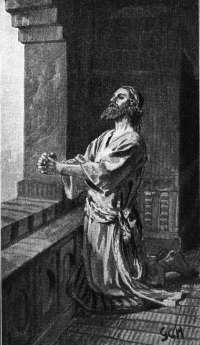
Think of this painting. It may help you to refocus on what
is transpiring during the climax of the Mass.

And no, Catholics don't recrucify Christ at every Mass.
He died once and for all for our sins, but the priest
re presents the timeless sacrifice to God the Father as Malachi prophesied. The Gentiles will present a pure sacrifice to God.

"For from the rising of the sun even unto the going down of the same my name shall be great among the Gentiles; and in every place incense shall be offered unto my name, and a pure offering: for my name shall be great among the heathen, saith the LORD of hosts."
(Mal 1:11)

The Browser of Our Hearts


I found a recent free software program that I hope folks will find helpful in their pursuit of holiness despite frequent use of the internet. As most honest Christian men will attest, they have had struggles with the sin of adultery..... per the internet that is. Most of us in a moment of weakness have been tempted to click on an inappropriate website. This is mortal sin and puts our souls at great peril if it goes unconfessed and unrepented of. Without the Sacrament of Confession in my life, I found that I often fell into the pattern of presumptuous sinning, knowing God would forgive me by saying a quick prayer and then promptly going forward and sinning again. I have been given much grace in the confessional and the ability to avoid sin has been strangely enhanced by frequent visits to Jesus in the confessional.
But back to the main point of the blog today, X3watch is a software program that sends the history of your internet browsing to an "accountability partner." Someone you trust who is spiritually looking out for your best interests. For a married person, the spouse is probably the best one to assist in the battle for purity. I think a computer browser these days will reveal more about a person than most anything else. Our interests, passions, strange musings all show up on the "history" on our browser. (Those vintage musical instrument websites are a dead giveaway where my heart has been lately.)

Jesus said, where your treasure is, there will your heart be. I say that in modern times, "where your browser is there will your heart be."
By looking at our browser, or letting someone else see it, we will open a window to the things we hold most dear that consume our time and interest.
I have installed this program on all the computers in the house and my wife is my accountability partner. I only wish that I would have more fear of the Holy Spirit looking at my browser history than my wife! Would that we all develop a true contrition that would make us obey Christ and seek purity, not out of fear of getting caught or the embarrassment of having to confess it, but of grieving the "Holy Spirit, the Browser of Our Hearts."

To download the free software: X3watch.com
Fo more help in the battle for purity, check out Ken Henderson's True Knights

"Oh My Jesus, Lover of chastity,
Mary, Mother most pure,
and Joseph, chaste guardian of the Virgin,
to you I come at this hour,
begging you to plead with God for me.

I earnestly wish to be pure in thought,
word and deed in imitation of your own holy purity.
Obtain for me, then,
a deep sense of modesty
which will be reflected in my external conduct.

Protect my eyes, the windows of my soul,
from anything that might dim the lustre of a heart
that must mirror only Christlike purity.

And when the "Bread of Angels" becomes the "Bread of life" for me
in my heart at Holy Communion,
seal it forever against the suggestions of sinful pleasures.
Heart of Jesus, Fount of all purity,
have mercy on us. "

Saturday, October 21, 2006

"God Told Me".... The Potential Dangers of Charismatic Renewal


I am thankful for the devotion and fervor for God found in the charismatic movement but Christians need to be made aware of the potential for abuse and heresy that can occur.


I would never deny the role of the Holy Spirit in the Church today regarding gifts, miracles and other manifestations but have become keenly aware of the abuses that can occur when the "spirit" is given "free" reign outside of any boundaries. (I mean after all, Catholics have 2000 years of documented eucharistic miracles, incorruptible saints, levitation, bilocation and other completely outrageous charismatic goings on) Poor St. Joseph of Cupertino having to wear heavy chains around his ankles to keep from levitating while at prayer! I hate when that happens.

The following 6 "potential dangers of charismatic renewal" are taken from the blog Per Christum. I had personally experienced and/or witnessed all of the following "Dangers" and have touched on many of them in my post "My personal conversion story."

1. Illuminism - i.e. folks believe God is telling them something unique that nobody else knows. There is a need to feel "special" and if God isn't telling you something unique or even mildly provocative, your credibility as a leader/follower is called into question. In my parents Sunday school class when I was in college, there were about 5 people who always said "God told me to..." whether it was which car to buy or even to get up in the morning. Not only does this destroy the free will God created us with, but how can you argue with "God told me..."??

2. Paraclericalism - a downplaying of the role of clergy, or even suggesting there is no need for the Church hierarchy. I have seen this attitude even among charismatic clergy! There is such an emphasis on the experience of the individual, that any kind of formality or hierarchy is looked down upon. The result for some Catholics is to downplay the role of the Holy Spirit acting in the Church, because the Church and her rules seem too "formal," and the hierarchy too "stifling." This leads some charismatic Catholics to become cafeteria Catholics, believing only in what gets them spiritually "excited."

3. Charismania - attributing excessive significance to the charisms while downplaying other spiritual acts. I have seen this, not so much firsthand, but from the testimony of others. Speaking in tongues or prophecy become the litmus tests for true spirituality, while feeding the hungry, clothing the naked, etc, are downplayed or even ignored. In some churches, the more outrageous the "charismatic" event, the more the Holy Spirit is deemed present. Unfortunately, this means the Holy Spirit is never allowed to work in a dignified and quiet manner.

4. Neglect of Traditional Spirituality - i.e. past spiritual experiences are downplayed or not even studied because it is all about what "I" am experiencing "now." This can also be seen when the traditional liturgy is "suspended" when the Spirit leads to be replaced by often questionable pet projects of the pastor. There is also a hostility to formality, and to suggest that something should be done a proper way (such as clerical dress or properly executing an essential part of the liturgy) is viewed suspiciously.

5. Tyranny of the Prophetic - This means that the prophetic, in this case referring to the illuminism mentioned above, can trump anything. In other words, if there is an objection to what the pastor is doing, the pastor just reminds the objectors that he talked to Jesus and "God told him..." and that settles it. 2000 years of Tradition is forced to submit to the private revelation of one pastor.

6. Cult of Personality - I have to add this after reading the comments to the post. One commenter makes a good point in that in some charismatic churches, and even charismatic movements, a cult of personality can develop around the pastor or leader. Despite a general suspicion of traditional hierarchy and church order among some charismatics, the pastor, who has been given special prophetic knowledge, is often viewed idealistically. The result is that he can do whatever he wants without discipline or question, including taking huge sums of money from the congregation. Why? Well it goes back to number 5 above. He has spoken with God. That settles it!

For my non-Catholic readers, I need to make certain it is understood that I do not discount the move of the Holy Spirit in our Church or non-Catholic fellowships. But to sum up "The Holy Spirit operating in the individual will not contradict the Holy Spirit operating in Christ's Church."(from David B. on Per Christum)

Friday, October 20, 2006

Finding God in the Pots and Pans.


In 1976, I entered my first year of college. As I wandered through the bookstore that first day purchasing text books, I happened upon a little paperback book that became my favorite devotional book for the next twenty years, next to the bible. Practicing the Presence of God by Brother Lawrence. He was born in the Lorraine province of France in 1605 and became a soldier. After the war he was led to become a lay monk in the Dicalced Carmelite order in Paris and spent the rest of his life working in the kitchen and later repairing the sandals of the 100 or so monks at the priory.

Brother Lawrence was able to cultivate a constant devotion and communion with God all the while still having to wash pots and pans, order wine, and repair sandals. He wrote about how he did this in letters to a close acquaintance and these letters were later published after his death. This spirituality of walking with God in a constant awareness of His presence has been a challenge and a blessing to millions of believers since the 17th century who have read the letters of this simple monk. I was greatly blessed to finding his writings in a bookstore some three hundred years after they were written. It's ironic to me now how one of the most influential devotional books in my Christian life was written by a monk in a church that I had long left as stale and irrelevant.

"God knows best what we need. All that He does is for our good. If we knew how much He loves us, we would always be ready to receive both the bitter and the sweet from His Hand. It would make no difference. All that came from Him would be pleasing.

The worst afflictions only appear intolerable if we see them in the wrong light. When we see them as coming from the hand of God, and know that it is our loving Father who humbles and distresses us, our sufferings lose their bitterness and can even become a source of consolation.

Let all our efforts be to know God. The more one knows Him, the greater one desires to know Him. Knowledge is commonly the measure of love. The deeper and more extensive our knowledge, the greater is our love. If our love of God were great we would love Him equally in pain and pleasure."

He passed away a few days after he wrote this last letter.
I encourage any believer to read this short little book. I believe it can be helpful in drawing you closer to God. It is available as a free download from this website:
PracticeGodsPresence.com

Thursday, October 19, 2006

Sometimes We Can't Pray as We Ought


In the New Testament, we are told that sometimes "we can't pray as we ought so the Spirit itself maketh intercession with groanings that can't be uttered." (Romans 8:26)
There are times in our life when a situation has us "prayerless." Where we just can't muster the words to pray. My former charismatic teachings suggested that this was when your "prayer language" could take over. I was never gifted with a prayer language but was open to the possibility. Now, I find that at times like this the intercession of the Spirit comes through for me in prayers written by others. These prayers can be short or long and can be useful to mirror the pangs of our heart that we can't seem to express. This one is a litany that was forwarded to me and came at a much needed time. Litany is from the latin word litania meaning prayer or supplication. This one is from the Catholics United for the Faith website.


Litany for the Protection and Guidance of Our Children

Lord, have mercy on us.
Christ, have mercy on us.
Lord, have mercy on us, Christ, hear us.
Christ, graciously hear us.
God, the Father of Heaven, have mercy on us.
God the Holy Spirit, have mercy on us.
Holy Trinity, one God, have mercy on us!

Mary, Mother of God . . . pray for us and for our children (repeat after each intercession)
St. Joseph, role model of Christian homes . . .
St. Michael, St. Rafael, and St. Gabriel . . .
All you guardian angels . . .
All you saints in Heaven . . .

From wrong companions . . . shield them, O Lord
From bad magazines . . .
From evil TV shows . . .
From filthy images and words on the Internet . . .
From worldly music and lyrics . . .
From violent movies and bad language . . .
From all the snares of the devil . . .

For guidance to make good choices . . . please, send them Your Holy Spirit
For guidance to discern situations . . .
For guidance to despise vanity . . .
For guidance to suppress pride . . .
For guidance to recognize and avoid the occasions of sin . . .
For guidance to banish evil thoughts and imaginations . . .

That they may love what is good . . . we beseech Thee, O Lord
That they may recognize the needs of others . . .
That they might be selfless in humble service to others, especially within their own families . . .
That they may joyfully make sacrifices . . .
That they have a great desire to hear and read Holy Scripture . . .
That they may grow in holiness . . .
That they understand more clearly that no one enjoys interior peace of heart who turns away from You and is disobedient to Your will . . .
That they may all reach heaven . . .

Lamb of God, Who takes away the sins of the world . . . spare us, O Lord.
Lamb of God, Who takes away the sins of the world . . . graciously hear us, O Lord.
Lamb of God, Who takes away the sins of the world . . . have mercy on us, O Lord!

Wednesday, October 18, 2006

Beloved Physician Saint Luke and the Hippocratic Oath


Today the Church celebrates the life and writing of one very important physician, Saint Luke. The only gentile to write a gospel he also wrote about the deeds of Peter and Paul in the Book of Acts. Paul referred to him as the "beloved physician." I feel honored to be a part of a profession that goes back to the days even before Christ walked the earth. Yet, I feel saddened at the departure many physicians have made from their original Hippocratic Oath. Most folks don't know this but the original oath prohibited physicians from giving an abortifacient as well as any drug to end life!

"I will neither give a deadly drug to anybody who asked for it, nor will I make a suggestion to this effect. Similarly I will not give to a woman an abortive remedy. In purity and holiness I will guard my life and my art."

Saint Luke probably took the original oath in order to practice his art and I also took this oath. Though in 1985, at my state medical school, the oath I swore was barely recognizeable as the Hippocratic Oath, since they removed all references to abortion and euthanasia.

Let's ask Saint Luke on his feast day, to ask God for the grace for physicians to return to the original oath that was life affirming and completely in accord with the Gospel of Life.

St Luke, I ask you to speak to God on my behalf for the grace and strength to practice my art in "purity and holiness." So God will be glorified and someday I will hear the Lord call me a beloved physician.

"Creeds, Schmeeds, Who Needs'm?"


I happened upon a website today that described the faith statement of an "emerging looking" church. They had the Nicene and Apostle's creeds on their site and said that their faith comes from the ancient truths expressed in these creeds. Yet when I read further down and came to their "contemporary statement of faith" they stated that "we believe neither baptism or the Lord's supper has any merit in obtaining eternal salvation." Yet, the Nicene Creed states "we believe in one baptism for the forgiveness of sins." The early church believed that one needed baptism to begin the process of salvation and believed that baptism was not symbolic but regenerational for the sinner.


So what's my issue here? I respect the right for anyone to state their views regardless of how divergent from mine. However, to wave the Creeds around like a flag but deny the very doctrines they espouse doesn't make sense to me.
I am intrigued by the ancient/future church movement as I have talked about before because those folks are taking an honest unbiased look at the early church with its creeds and making statements like "the Call" which I blogged on before. These are folks who I hope and pray will eventually feel the call to Rome as they learn more about the early church which was Catholic in creed, practice and name as well. But for a church to advertise their belief in the Apostles and Nicene creeds on their website displayed with a celtic cross, and then go out and create your own contradicting statement of faith.....I just don't get it. It's like saying "creeds, schmeeds, who needs'm." What do you think?

Monday, October 16, 2006

"Why Liturgy Works for Me"


Getting back to my blog about the Mass, I was reflecting how the Liturgy is a constant and the priests in the Church are instructed that "the liturgy belongs to the Church, not the priest." Therefore, he is not allowed to inject his own words, tenses, or paraphrases during the Mass. For me, this removes the human tendency to infuse one's own agenda (spin) in the Mass. This "stays" the fleshly nature of man's hand so to speak and allows God to speak and infuse His grace through the liturgy.
I used to think of Catholicism as a "man-made religion with man-made liturgies" but now I see that the Liturgy of the Mass is evidence of God's divine protection and love so that we don't allow man (meaning, the priest) to change the liturgy to suit his fancy. So rather than being man-made, it is God-breathed and does not allow for personal interpretation or expression by a particular priest's point of view. (Please see my post on how much of the Liturgy is based on God's Word.)

Finally, regarding the universal indult that is soon to be delivered by the Pope. If the Mass said in Latin continues to protect the Liturgy and keep us from "messing with it", then I am all for it. With the Mass in Latin, there will be less tendency and temptation to "customize" the Liturgy as many of the priests today don't have a working knowledge of Latin. I am thankful for my parish where the priests respect the liturgy and don't ever "make it their own."
Here's the CCC on liturgy:
1125 For this reason no sacramental rite may be modified or manipulated at the will of the minister or the community. Even the supreme authority in the Church may not change the liturgy arbitrarily, but only in the obedience of faith and with religious respect for the mystery of the liturgy.

So this is why Liturgy works for me. Because it is ordained by God through His Church and removes the opportunity for man-made manipulation that can be so tempting in this present culture.

Sunday, October 15, 2006

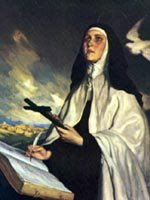
"Nada te turbe" Teresa of Avila


Today the Catholic Church celebrates the life of Teresa of Avila. She was born in Spain in 1515 at the start of the Reformation and lived until 1582 to see the beginnings of the Counter Reformation in the Council of Trent. She was a contemplative, mystic and reformer and one of the first women recognized as a Doctor of the Church. She did much to bring the Carmelite order back to its original rule and had much success in turning around the carmelite monasteries that were becoming too worldy. She wrote many volumes of poems, books and letters. Her exhumed body nine months after burial was incorrupted and gave off a beautiful perfume of an odor that filled the monastery. She was canonized in 1622 and made a Doctor of the Church in 1970.

"Let nothing upset you, let nothing startle you. All things pass; God does not change. Patience wins all it seeks. Whoever has God lacks nothing: God alone is enough"

Saturday, October 14, 2006

On This Rock

"The Mass is So Boring"


When I left the Church in 1973, I was immediately impressed with the spontaneity and excitement that was found in the independent charismatic church I started to attend. The prayers were spontaneous, the singing was often spontaneous and the pastor with no formal education was even more spontaneous! Having never experienced this before, it was a delight to my senses and being newly converted I was told this was "normative Christianity." Meaning; this is how the church normally operated.
Fast forward 25 years. At this point my senses were more than overstimulated and perhaps my middle age was showing but I began to dread the spontaneity of the services. Would the worship time go for 30 minutes , or an hour or two? Would the sermon be cancelled because of the Spirit was directing us to have an altar call? Would the service come to a grinding halt when an individual felt led to give a prophecy? Or would the worship leader feeling we weren't "quite "breaking through yet" signal for the musicians to put down their instruments and stop the music? All of these things were certainly done with the attitude of allowing God to be in control and I was always impressed with the humility of my pastor putting away his sermon in order to allow the service to proceed in another direction.... But..., was this "normative Christianity?"

For the past two years, my study of the early church presented through the writings of the Early Church Fathers and other historical documents has led me to a different conclusion. I blogged on this before so I won't go into the details, but normative Christian worship has always been centered on the Liturgy of the Mass with the Eucharist being the focal point. Now that I am Catholic and have experienced yet another conversion, I can see the Mass as anything but boring .

In America where LCD projectors, audiophile-quality sound sytems, professional dance and drama presentations rule the day on Sunday mornings, a liturgical based worship could "look" boring. Once I realized what the liturgy meant and knowing that the priest uses some of the same prayers used in the 1st century church, I get chills! At the point of consecration, heaven opens and all the angels on earth and in heaven adore the Holy One! Then, I have the privilege of participating in this grand feast and receiving Christ physically in the Eucharist.

No, I'm not bored anymore.

An excellent book that can help us to see and understand the beauty of the Mass is Thomas Howard's "If your Mind Wanders At Mass." (Thomas Howard is Elizabeth Elliot's brother and a renowned scholar and convert)

Friday, October 13, 2006

Let Me Be Merciful

I have discovered the joy of praying written prayers. It forces me to not rely on myself, my own intellect my own desires or imaginations. After 30 years of spontaneous prayer, it was a little hard initially to get use to praying as I read the words from someone else's devotional life. I found though these prayers from this saint too irresistible to be kept for her alone. I need to humble myself and admit; I need my heart to echo the word's of this believer. May God give us all the mercy that Saint Faustina prayed for.

I want to be completely transformed into Your mercy and to be Your living reflection, O Lord. May the greatest of all divine attributes, that of Your unfathomable mercy, pass through my heart and soul to my neighbor.

Help me, O Lord, that my eyes may be merciful, so that I may never suspect or judge from appearances, but look for what is beautiful in my neighbors' souls and come to their rescue.

Help me, that my ears may be merciful, so that I may give heed to my neighbors' needs and not be indifferent to their pains and moanings.

Help me, O Lord, that my tongue may be merciful, so that I should never speak negatively of my neighbor, but have a word of comfort and forgiveness for all.

Help me, O Lord, that my hands may be merciful and filled with good deeds, so that I may do only good to my neighbors and take upon myself the more difficult and toilsome tasks.

Help me, that my feet may be merciful, so that I may hurry to assist my neighbor, overcoming my own fatigue and weariness. My true rest is in the service of my neighbor.

Saint Faustina, Pray for us to have a heart for God and others as you did. You are with Him now, close to His heart of mercy. Pray for this grace for me . Thank you Saint Faustina for your prayers for me today.